
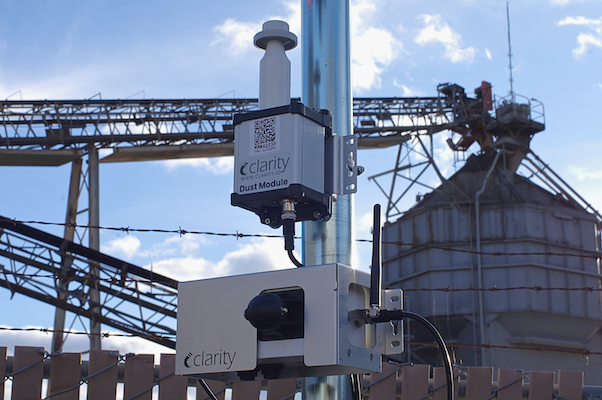
Additional siting considerations for the Clarity Node-S are available here.
It is important to survey the site prior to the deployment date, if possible. A site survey will help with the following:
- Identify exactly where you will mount the device
- Make sure that you have all the necessary tools and mounting accessories for installation. You can find more information about the mounting options and supplies needed on the page deploying your Dust Module.
- It is often helpful to take photos of the site or draw diagrams that you can refer to later.
Once at the site, you will need to identify a mounting location. The Dust Module can be mounted above, below, or next to the Node and can be secured to a pole, fence, or railing using zip ties or hose clamps. To ensure the Dust Module is properly sited
-
Avoid installing near known sources of heat and moisture (e.g., an external HVAC unit) and direct pollution sources (e.g., a restaurant's exhaust vent),
-
Be at least 6 meters (20 ft) away from any obvious pollution sources like an exhaust vent, generator, or outdoor grill,
-
Maintain a vertical gap of at least 25 cm (10 in) above the Dust Module to ensure unobstructed inlet airflow and prevent water splashing between the devices in case of heavy rain,
-
Ideally, the monitors would be placed away from buildings to improve airflow. If you need to install the monitor on a building surface, place it on the upwind side of the building,
-
Allow for mounting at a height of approximately 3-5 m (10-16 ft) from street level to measure general population exposure; higher to capture data on more regional air quality,
-
Be in a secure location, if possible, behind a fence or in areas that aren’t highly trafficked,
-
If using the Clarity External Power System (EPS), it’s important to check that the location is not in the shadow of buildings, trees or other infrastructure. The device and solar panel will need to be facing south (northern hemisphere) or north (southern hemisphere). For additional siting considerations, see External Power System siting guidance.
-
If powering via the provided wall adapter, ensure cords are appropriately weatherproofed.